
The Ouija Board in the Old Chapel
There have been numerous unexplained incidents at Appleby Castle over the years. Some are easily dismissed. Others are rather more difficult to forget.
One particular evening in 2012 remains firmly etched in our memories.
A group of teenagers were taking part in a paranormal evening and had placed a Ouija board on the floor of the old chapel. None of them had any particular knowledge of the families who had once owned Appleby Castle, and certainly no detailed knowledge of medieval genealogy.
At first, it was all treated rather light-heartedly.
A thick, heavy glass was placed on the board and the group began asking questions. Before long, however, the mood changed. The glass started to move slowly around the board.
They asked:
“What is the first letter of your first name?”
The glass moved to:
H
Someone asked:
Is your name Henry?
The glass moved slowly to:
YES
So far, of course, it could have been coincidence — or perhaps one of the group unconsciously moving the glass.
Then they asked where Henry had been born.
The glass moved to the letter:
S
The group began suggesting places and eventually asked:
Were you born at Skipton?
Again, the glass moved to:
YES
Interesting perhaps — but still hardly proof of anything.
Then came the question which made the incident rather more difficult to explain.
And this is where it became interesting…
The group asked:
What year were you born?
The glass moved across the board and indicated:
1493
The number meant absolutely nothing to anyone taking part.
Nobody suddenly announced that they knew who the supposed “Henry” was. There was no dramatic revelation. The session simply continued.
It was only around twenty minutes later that the date was checked.
The result was unexpected.
Henry Clifford, later the 1st Earl of Cumberland, was born at Skipton Castle in 1493.
He was a member of the Clifford family who owned Appleby Castle for centuries, and he would certainly have known the rooms and buildings around the area in which the session was taking place. The great rebuilding of Appleby Castle in the fifteenth century had been undertaken by his grandfather, Thomas Clifford, 8th Baron de Clifford, in 1454.
Now, there are plenty of possible explanations.
Perhaps somebody moved the glass without realising it. Perhaps somebody knew more history than they admitted. Perhaps the letters and numbers simply happened to form an extraordinary coincidence.
That is entirely possible.
But for those who were there that evening, one question has always remained:
What are the chances that a group with no apparent knowledge of the Clifford family would arrive at the name Henry, the birthplace Skipton, and the year 1493 — and only afterwards discover that all three matched a real former owner of Appleby Castle?
We cannot tell you what moved the glass.
We can only tell you what happened.
And you can decide for yourself.
Appleby Castle is the kind of place where, if you spend long enough looking for the unexplained, you may eventually find something that makes you question what you thought you believed.
Are you brave enough to discover what happens after dark?
Step inside Appleby Castle after dark and experience nearly 1,000 years of history in a completely different way.
From its Roman origins to centuries of conflict, loss, restoration and occupation, Appleby Castle has witnessed generations of lives, events and untold stories. Over the years, visitors, staff and paranormal investigators have , rooms, towers and corridors.
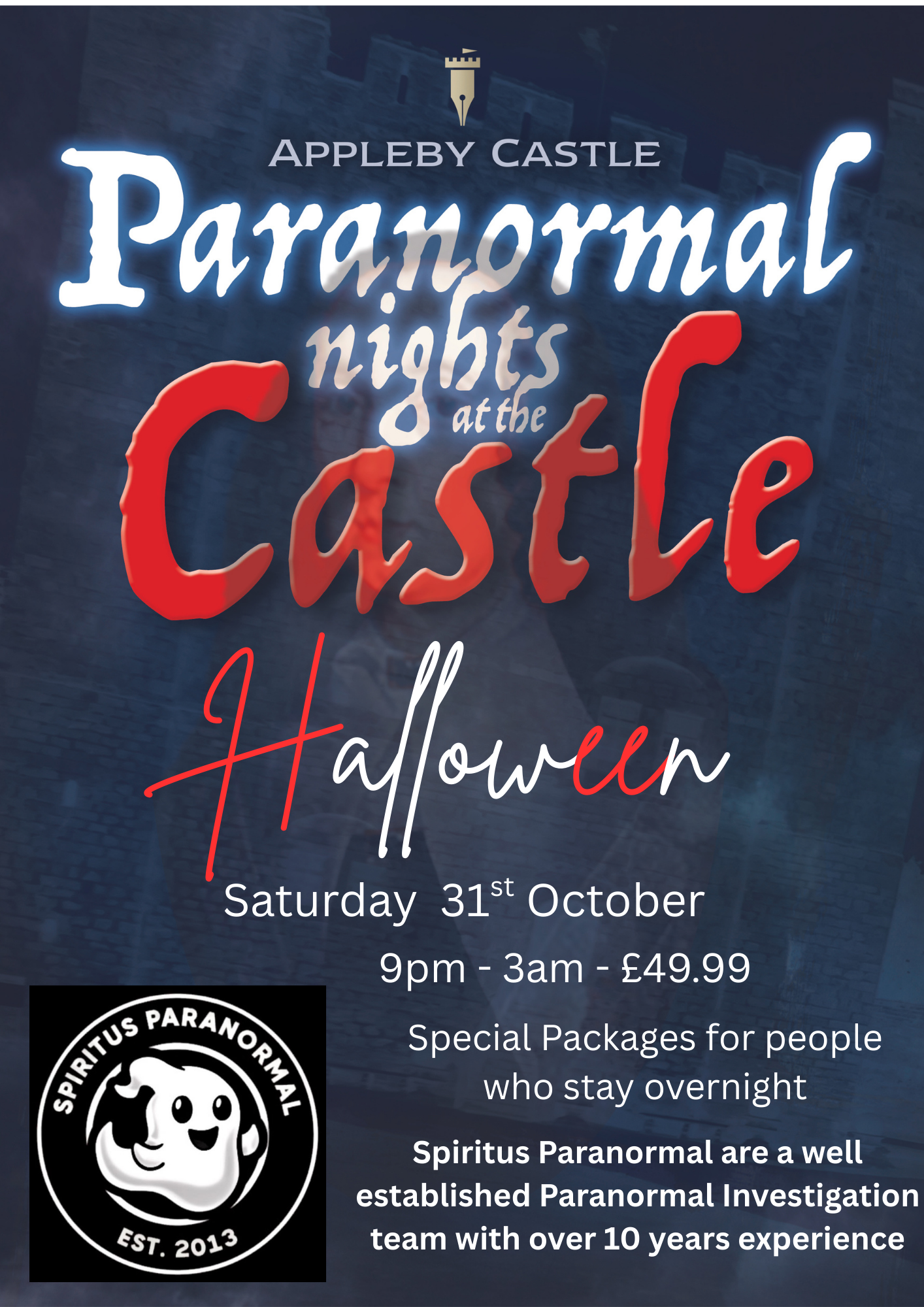
This Halloween, you are invited to discover the Castle after hours.
Meet in the atmospheric 12th-century Great Hall, where your evening will begin before you move through selected areas of the Castle for a series of guided paranormal investigation sessions.
Arrival from 8.30pm — investigation begins at 9.00pm.
Whether you are a committed paranormal investigator, a curious sceptic, or simply fascinated by historic places after dark, this promises to be a memorable and unusual night inside one of England’s most historic castles.
Paranormal Investigation Activities
Throughout the evening, an experienced paranormal team will guide you through a range of traditional and modern investigation techniques designed to explore unexplained activity within the Castle.
Traditional Methods
Take part in classic paranormal investigation techniques including:
Table tipping
Séance sessions
Human pendulum experiments
Writing planchette sessions, encouraging possible initials, words or simple drawings
Modern Investigation Equipment
You will also have the opportunity to use specialist paranormal investigation equipment, including:
Thermal cameras— used to identify unusual changes in temperature and movement in darkened rooms
Motion-activated infrared trap cameras— silently monitoring historic spaces for unexplained movement
Spirit boxes — used by investigators in attempts to capture responses through rapidly scanning radio frequencies and white noise
REM pods — designed to react to changes within the surrounding electromagnetic field
K2 meters— used to detect fluctuations in electromagnetic activity
Trigger objects, including music boxes and illuminated cat balls, positioned within rooms to detect possible movement or interaction
And, for those who feel brave enough, there may also be an opportunity to take part in a Ouija board session.
As the Castle falls quiet and the lights are lowered, you will have the chance to explore rooms and corridors that feel very different once the daytime visitors have gone.
Will the equipment remain silent?
Will something move when no one is near it?
Will you hear footsteps in an empty corridor — or receive an unexpected response during one of the investigation sessions?
There is only one way to find out.
Halloween Paranormal Investigation at Appleby Castle
Limited places available — advance booking strongly recommended.
Someone Still Walks the Staircase.
On another occasion, a group of mediums visited Appleby Castle to carry out a preliminary walk-through before a paranormal evening.
As they moved through the Castle, one of the mediums stopped on a staircase and said that they could sense the presence of a man who had once worked there.
What made the moment more interesting was that we had a collection of old photographs showing former footmen, servants and staff who had worked at Appleby Castle many years before.
Without being given any information about the people in the photographs, the medium was shown one of the old group pictures and immediately pointed to a particular man.
The medium then gave us a name.
At the time, the name meant nothing to us.
There was no immediate way of knowing whether it had any connection with the Castle, and the incident could quite easily have been dismissed as guesswork.
But we decided to investigate.
For around two weeks we searched through historical records, trying to establish whether the name belonged to anyone associated with Appleby Castle.
Eventually, we found him.
The man identified in the photograph had indeed worked in Appleby.
He was recorded as a groom.
That discovery made the original encounter rather more difficult to dismiss. The medium had not simply described a vague figure or suggested that a servant might once have walked the staircase. They had selected one individual from an old photograph and supplied a name which was later found to have a genuine historical connection.
Was it coincidence?
Was it an educated guess?
Or did the medium somehow identify a man who had once worked around the Castle and whose presence, for whatever reason, seemed still to be associated with that staircase?
We cannot say.
But, like so many experiences at Appleby Castle, it remains one of those incidents that is difficult to forget.
Elizabeth Sackville West
Another incident at Appleby Castle was far less dramatic, but in some ways even more intriguing.
One morning, a lady who had spent the night in one of the Castle bedrooms came down for breakfast looking rather puzzled.
Almost immediately she said:
“I just can’t get the name Elizabeth Sackville-West out of my mind. I have no idea who she is.”
There had been no discussion about the name the previous evening and, as far as she was concerned, it meant absolutely nothing to her. She simply described waking with the name firmly fixed in her thoughts and being unable to shake it.
It would have been very easy to dismiss.
Except that Elizabeth Sackville-West was not an invented name.
Elizabeth Sackville-West was a real nineteenth-century aristocratic name, belonging to a family with historic connections to the Sackvilles – the same wider family name that had already become entwined with Appleby Castle centuries earlier through Lady Anne Clifford’s marriage to Richard Sackville, Earl of Dorset.
What made the experience memorable was its apparent spontaneity.
The guest had not arrived asking about the Sackville family. She had not been researching the history of the Castle. She simply came downstairs the following morning and volunteered a very specific name which she said had repeatedly entered her thoughts during the night.
Perhaps she had encountered the name somewhere before and forgotten about it.
Perhaps it was nothing more than a strange coincidence.
But why that particular name, while sleeping inside an ancient castle with centuries of connections to the Clifford and Sackville families?
As with so many of the unexplained experiences reported at Appleby Castle, we cannot provide the answer.
We can only tell you what was said that morning.
And leave you to decide what you think happened.